






In modern fiber optic systems, where higher speed, bandwidth, and reliability are required, the fiber optic cleaning has become a critical factor for the performance of our connections. A single dust particle, oil residue, or a microscopic fingerprint can cause insertion losses, unwanted reflections, or intermittent failures that are difficult to diagnose.
Despite this reality, in many field installations, laboratories, and manufacturing processes, people still resort to using isopropyl alcohol (IPA) as a cleaning method. IPA is an organic solvent widely used in industrial and electronic applications due to its ability to dissolve certain contaminants and its apparent rapid evaporation. However, its use was not conceived for the cleaning of optical interfaces, where tolerances are microscopic and any residue can directly impact signal quality.
In fiber optic connector cleaning, the problem isn't just what you can see with the naked eye. Invisible contamination is the most critical. Even when a connector appears clean after applying IPA, residues, moisture, or redistributed particles can remain on the ferrule—enough to compromise link performance and cause rework, signal loss, or intermittent failures that are difficult to detect.
In this context, the use of generic solutions such as isopropyl alcohol is insufficient to meet today's fiber optic demands, where are required cleaning fluids and tools specifically designed to ensure a truly clean and reliable optical interface..
The use of isopropyl alcohol in cleaning of fiber optic connectors presents several technical disadvantages:
These limitations lead to incomplete cleaning and a false sense of security in the connection.
For effective cleaning, it is essential to use specialized fiber optic fluids. along with lint-free wipes. Unlike IPA, these fluids are formulated to:

This method allows for a true cleaning of the optical interface and significantly reduces the risk of signal loss or intermittent failures. An effective solution is provided by Fujikura FCC2.
In applications where precise and repeatable cleaning is required, there are tools specifically designed for the manual cleaning of fiber optic connectors. One example is the HandiMate from Seikoh Giken, which allows cleaning different types of connectors in a controlled, safe, and consistent manner, both in the field and in the laboratory.
This type of solution helps minimize improper contact with the ferrule and reduces the risk of re-contamination during the cleaning process.


When contaminants are persistent or the connector has been exposed to severe conditions, a deep cleaning of the fiber optic ferrule. For these cases, there are specialized solutions such as FerrulePro from Seikoh Giken, designed to remove residues that cannot be cleared with conventional methods.
This type of cleaning is especially useful before inspection, reconnection, or critical link measurement processes.
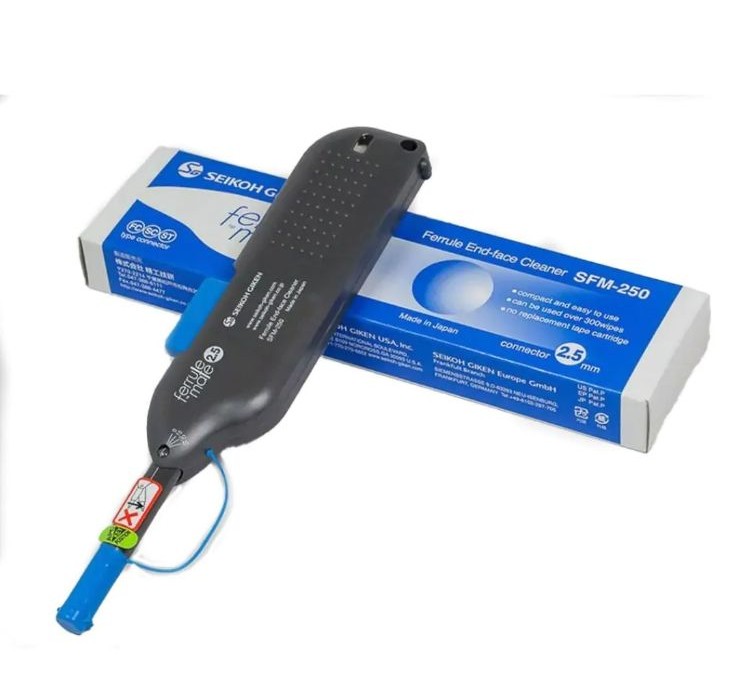
As a complement to a professional cleaning strategy, there are tools designed to directly clean the connector endface. Among them are systems such as the Ferrule Mate from Seikoh Giken which allow for quick and effective cleaning with just one click.

Isopropyl alcohol may seem like a practical solution, but does not meet current fiber optic cleaning standards. Its residues, low effectiveness against complex contaminants, and the risk of re-contamination make it an obsolete practice.
The use of specialized fluids, lint-free wipes, and professional cleaning solutions such as those developed by Seikoh Giken allows for truly clean optical interfaces, improving signal quality and reducing failures, rework, and operational costs. In fiber optics, proper cleaning is an essential requirement for link reliability.